Strawberry pests and problems
Frost, birds, grubs and mould: what goes wrong, and what the RHS suggests.
How this site works. Every fact is in our own words and linked to its source, beside it. Growing advice comes mainly from the RHS, the UK’s gardening charity.
Vine weevil
Vine weevil grubs love strawberry plants and are a bigger threat in containers, but they can be kept in check with biological controls. RHS
Vine weevil grubs are plump, C-shaped, white and legless, with light brown heads, and up to 10mm long. They eat roots, so plants wilt and die. RHS, vine weevil
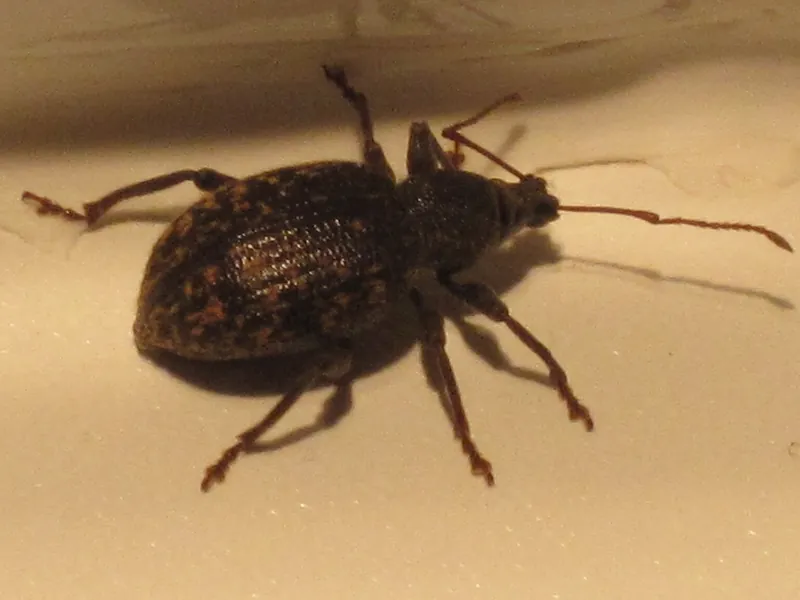
Adult vine weevils are dull black beetles about 9mm long that come out after dark and nibble notches in leaf edges. RHS, vine weevil
Grey mould
Grey mould is caused by the fungus Botrytis cinerea. On strawberries it causes a soft brown rot, often as the fruit ripens. RHS, grey mould
Grey mould spreads fastest in humid conditions, so it is a particular problem under glass. RHS, grey mould
Try not to wet the crown or the fruit when watering, as that can lead to fungal problems, especially grey mould. Water in the morning, not the evening. RHS
Put straw under the plants when fruits start to form. It keeps the fruit off the damp ground, so it stays clean and dry and is less likely to rot. RHS
Frost and black eye
Black eye is frost damage: the middle of the flower turns black while the petals stay white, and that flower won’t make a strawberry. RHS, black eye
Flowers in tight bud are fairly resistant to frost; open flowers are the most at risk. Avoid frost pockets. RHS, black eye
Strawberry plants are hardy, but if frost is forecast when they are in flower, cover them overnight with fleece, hessian or an old bedsheet. RHS
Birds and squirrels
To stop birds eating the fruit, cover the plants with taut netting on a frame before the berries ripen. Chicken wire also keeps squirrels off. RHS
Spotted wing drosophila
Spotted wing drosophila, a small vinegar fly first reported in Britain in 2012, is on the RHS list of common strawberry problems. RHS
Its female has a saw-like egg-laying tube that pierces the skin of fruit, so, unlike our native vinegar flies, it can damage nearly ripe and ripe, unblemished fruit, strawberries included. RHS, SWD
Slugs and snails
Containers avoid the soil diseases that build up in strawberry beds, and slugs and snails are less likely to reach the fruit. Vine weevils can be a problem, though. RHS
Slugs and snails aren’t all bad: they recycle dead leaves and are food for birds, beetles and reptiles. RHS, slugs and snails
Tired soil
The RHS lists strawberry as occasionally or slightly affected by replant disease, when a new plant struggles in soil where the same kind grew before. RHS, replant disease
A strawberry bed usually stays healthy for up to four years. Replant every three or four years, in a different place. RHS
Other problems
The RHS’s list of common strawberry problems also includes strawberry viruses, verticillium wilt, fruit aphids and phyllody, where flower parts turn into leafy growths. RHS
Our view: most strawberry trouble is prevented by three cheap things: straw under the fruit, a net over the top and a new bed every few years.
Next: the history →